





Cross-Border Supply Dynamics: Analyzing the Impact of India’s Sugar Export Ban and Ethanol Diversion Policy on Nepal’s Market Security
Executive Summary
The South Asian agricultural commodity trade is undergoing a structural transformation driven by India’s bioenergy policy objectives and aggressive domestic market interventions. As the world's second-largest sugar producer, India has systematically reoriented its sugarcane economy toward bioethanol production. This shift is designed to reduce national crude oil import reliance and achieve ambitious bioenergy blending thresholds. However, the diversion of sugarcane feedstock away from food processing, compounded by adverse weather events and shrinking national reserves, has led the Indian government to impose a comprehensive ban on raw, white, and refined sugar exports through September 30, 2026.
This sudden shift in trade policy presents immediate structural vulnerabilities for neighboring landlocked economies, most notably Nepal. Nepal relies heavily on Indian white sugar imports to bridge a chronic domestic supply deficit. With national sugarcane production meeting less than half of internal market demand, India's export restrictions have triggered retail price surges across Nepal, stimulated cross-border smuggling, and threatened the input cost stability of domestic fast-moving consumer goods (FMCG) and food processing industries.
Addressing this crisis requires Nepal to implement a dual-track strategy combining immediate trade diplomacy and fiscal adjustments with long-term agricultural and bioenergy policy alignment. In the short term, Nepal must leverage bilateral diplomatic channels to secure dedicated government-to-government import quotas and temporarily adjust customs tariffs on third-country imports to maintain price stability. Over the long term, Nepal must resolve structural payment delays to local farmers, modernize domestic milling infrastructure, and adopt its own ethanol blending framework to revitalize its sugarcane sector and strengthen national energy and food security.
The Indian Biofuel Imperative: Sugar Diversion, Export Restrictions, and Policy Drivers
India’s agricultural trade policy has undergone a fundamental transition from managing cyclical sugar surpluses to balancing domestic price stability against national bioenergy goals. The central driver of this pivot is the Ethanol Blending Program (EBP), which established a target of 20% ethanol blending in petrol (E20) for the 2025–26 Ethanol Supply Year. To achieve this mandate, the Indian Department of Food and Public Distribution systematically encouraged sugar mills and distilleries to divert sugarcane juice, B-heavy molasses, and sugar syrup directly into ethanol production.
The quantitative scale of this feedstock diversion has altered domestic sugar availability in India. During the 2022–23 sugar season, India diverted approximately 4.3 million metric tons of sugar equivalent to ethanol production. Although this volume moderated to 2.4 million metric tons in 2023–24 due to initial supply tightening, it expanded again to 3.4 million metric tons in 2024–25. For the 2025–26 season, industry estimates indicate an ongoing diversion of roughly 2.4 million metric tons of sugar equivalent toward bioethanol manufacturing.
This structural allocation of sugarcane to energy production coincided with severe climatic disruptions across major agricultural belts. Prolonged dry spells linked to El Niño conditions, alongside unseasonal rainfall patterns in primary producing states such as Maharashtra and Karnataka, severely depressed cane yields and reduced extraction recovery rates. Consequently, India’s sugar production for the 2025–26 season was projected at 27.5 million metric tons, falling short of its annual domestic demand baseline of 28 million metric tons. Facing a domestic supply deficit, historically low reserves, and food inflation pressures, the Indian government enacted an immediate export ban on raw, white, and refined sugar effective through September 30, 2026.
To tame domestic price surges ahead of high-demand festive seasons, the Indian government took the unusual step of opening a duty-free import window for up to 1 million metric tons of raw sugar through October 31, 2026, temporarily suspending its standard 100% protective import tariff. Concurrently, strict inventory controls were imposed on domestic sugar dealers and bulk industrial consumers to prevent speculative hoarding.
Despite the comprehensive nature of the commercial trade ban, specific policy mechanisms were maintained to accommodate foreign policy priorities. Beyond pre-cleared transit stock and specialized Tariff Rate Quota (TRQ) commitments to the European Union and the United States, Point 5 of the notification issued by the Directorate General of Foreign Trade (DGFT) explicitly empowers the Indian government to approve dedicated sugar exports to friendly partner nations upon direct government-to-government (G2G) request to fulfill strategic food security needs.
Vulnerabilities in Nepal’s Sugar Supply Chain: Domestic Scarcity and Structural Deficits
Nepal's vulnerability to external trade restrictions stems directly from a widening gap between national consumption requirements and domestic agricultural output. Nepal's annual sugar consumption ranges between 270,000 and 300,000 metric tons. Domestic production from the nation's 12 to 13 operating sugar mills covers only 100,000 to 120,000 metric tons under average harvest conditions. This creates a structural annual supply deficit of 150,000 to 180,000 metric tons that must be fulfilled through foreign imports, historically dominated by Indian suppliers.
National sugar demand follows two primary consumption streams. Direct household consumption accounts for approximately 65% of total national demand, while industrial manufacturing—including juice, confectionery, biscuit, beverage, and dairy processors—consumes the remaining 35%. National demand peaks during the major autumn festival season encompassing Dashain, Tihar, and Chhath, when monthly consumption surges from a baseline of 20,000–25,000 metric tons to over 30,000 metric tons.
The domestic sugarcane sector suffers from long-term structural contraction, leaving local mills unable to expand production to meet national demand. Cultivated sugarcane acreage in Nepal shrank from 68,565 hectares in FY 2019/20 to 62,225 hectares in FY 2023/24. Over the same period, total sugarcane harvest volumes declined from 3.4 million metric tons to 3.1 million metric tons. Agricultural productivity remains low, averaging between 39.5 and 45.2 metric tons per hectare. This performance falls well short of recommended regional target yields of 70+ metric tons per hectare and trails productivity benchmarks set by major global producers. Furthermore, Nepal's industrial extraction recovery rate remains depressed at 8.83% to 9.0%, meaning less commercial sugar is extracted per ton of processed cane.
The primary driver of this agricultural decline is a persistent liquidity crisis within the sugarcane value chain. Nepalese sugar mills, operating under constrained working capital, have repeatedly delayed payments to farmers. In major producing districts such as Mahottari, Sarlahi, Sunsari, and Rautahat, these payment arrears have frequently dragged on for months or years. Faced with delayed compensation, rising labor expenses, and elevated prices for seeds and fertilizers, thousands of farmers have abandoned sugarcane in favor of staple food crops like paddy, wheat, and maize, which offer reliable, short-term cash liquidity.
As a direct consequence of this agricultural contraction, Nepalese sugar mills operate at only 45% to 50% of their total crushing capacity due to raw material shortages. Rather than operating through mid-May as historically observed, factories regularly exhaust local cane supplies and shut down by mid-February. This underutilization creates a self-reinforcing cycle of low mill profitability, financial distress, delayed farmer payments, and shrinking crop acreage.
Socio-Economic Ripple Effects across Nepal’s Domestic Economy
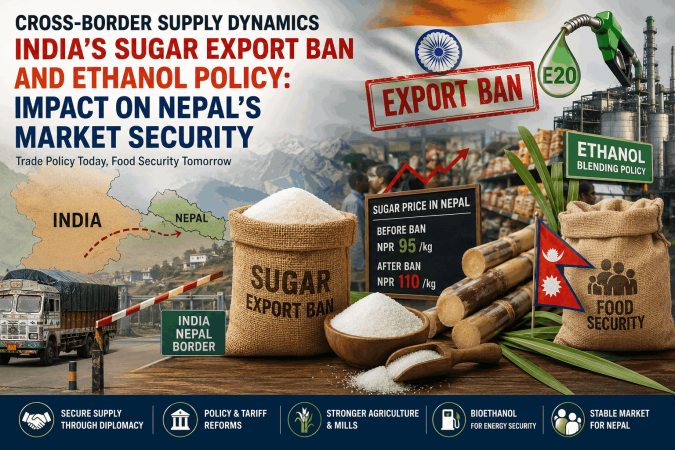
India’s sugar export ban has triggered immediate socio-economic disruptions throughout Nepal, affecting retail markets, border security, and industrial manufacturing. Following the export ban, retail sugar prices in major urban centers jumped by approximately NPR 15 per kilogram, escalating from NPR 95 to NPR 110 per kilogram. Although existing domestic mill inventories (estimated at roughly 80,000 metric tons at the start of the restriction) prevented physical market depletion, market uncertainty led to price gouging and speculative hoarding ahead of festival seasons.
The restriction on legal trade channels has exacerbated cross-border smuggling along the open southern border in the Tarai-Madhesh region. Interdictions by Nepal’s Armed Police Force (APF) resulted in sugar confiscations more than doubling month-over-month in border districts such as Jhapa, Morang, and Sarlahi. While illegal trade partially satisfies consumer demand in border towns, it deprives the national treasury of customs duties, undercuts legitimate wholesalers, and exposes domestic consumers to uninspected, substandard products.
Simultaneously, Nepal’s industrial food processing sector faces escalating input cost pressures. Beverage, juice, biscuit, confectionery, and chocolate manufacturers rely on refined white sugar as a foundational raw material. The competitiveness of this sector is heavily influenced by trade policy and tariff structures. Under Nepal's prevailing customs schedule, sugar imported from India carries a 30% customs duty, whereas imports from third-country suppliers such as Brazil or Pakistan are subject to a 40% tariff.
This 10% tariff differential renders third-country imports financially unviable for private industrial end-users without government duty interventions. Unable to source sufficient duty-paid Indian sugar or afford high-duty third-country imports, domestic manufacturers face compressed operating margins, mandatory product price increases, or forced production cutbacks.
Strategic Options and Policy Solutions for Nepal
Navigating the cross-border trade disruption caused by India's ethanol policy requires a comprehensive policy response. Nepal must combine short-term diplomatic and fiscal interventions with structural reforms to modernize domestic agriculture and integrate bioenergy production.
Diplomatic Interventions and Government-to-Government Procurement
To alleviate immediate market deficits, the Nepalese government must prioritize formal bilateral diplomacy under the specialized exemption mechanisms of India's trade policy. Paragraph 5 of the notification issued by the Indian Directorate General of Foreign Trade (DGFT) explicitly permits state-level sugar exports to meet the humanitarian and food security needs of neighboring nations upon formal government request.
Nepal has established successful precedents using G2G procurement models. During prior Indian trade suspensions, Nepal negotiated a dedicated allocation of 25,000 metric tons of sugar through India's National Cooperative Exports Limited. The Ministry of Industry, Commerce, and Supplies should operationalize remaining quotas under existing agreements while initiating top-level bilateral talks to secure a fresh duty-free annual allocation. Directing these consignments to state-backed entities, specifically the Salt Trading Corporation (STC) and the Food Management and Trade Company (FMTC), ensures imported stocks are distributed efficiently at stabilized prices during high-demand festival periods.
Fiscal and Tariff Structure Rationalization
To reduce single-source dependency on Indian supply, Nepal must update its customs framework to make third-country imports commercially viable for industrial and state buyers. The main barrier to global sourcing is the 10% tariff penalty imposed on non-Indian commodities.
To address market imbalances, the Ministry of Finance should issue targeted, time-bound fiscal adjustments:
Equalize the basic customs tariff on raw and refined sugar imports from third-country origins (such as Brazil or Pakistan) down to 30%, matching the standard Indian rate for industrial buyers.
Grant temporary 50% customs duty waivers to state procurement agencies (STC and FMTC) for seasonal import consignments (e.g., 30,000 metric tons), replicating successful intervention strategies used during previous supply pinches.
Institute inventory reporting mandates and price ceilings for commercial importers benefiting from duty reductions to prevent speculative hoarding and ensure cost savings are passed on to end consumers.
Overhauling Agrarian and Milling Capacity
Achieving long-term food security requires restoring domestic sugarcane farming and modernizing national processing infrastructure. Reversing the contraction of domestic production involves resolving key operational and structural challenges:
Eliminating Farmer Payment Arrears: To rebuild trust among growers, the government must enforce an automated payment system. Sugar mills should be legally required to deposit procurement funds into designated escrow accounts, enabling direct automated transfers to farmers' bank accounts upon crop delivery.
Dynamic Minimum Support Pricing: The Minimum Support Price (MSP) for sugarcane must be indexed annually using a transparent formula that reflects local inflation in agricultural labor, land preparation, and fertilizer costs. Additionally, direct government subsidies must be transferred cleanly to farmers via digital treasury channels to prevent administrative delays.
Yield Optimization and Agricultural Extension: The Nepal Agricultural Research Council (NARC) must collaborate with regional agricultural offices to distribute certified, high-yielding seed varieties capable of achieving yields of 70+ metric tons per hectare, doubling current farm productivity.
Milling Modernization and Extraction Efficiency: Sugar factories require access to concessionary capital to upgrade aging crushing machinery, aiming to raise national extraction recovery rates above 10%. Increasing mill capacity utilization from current levels (~45–50%) toward full operational potential would enable domestic processors to satisfy national consumption requirements.
Bioenergy Integration: Implementing Nepal’s Ethanol Blending Framework
Establishing a domestic bioethanol industry represents a structural solution that can stabilize the sugar sector while reducing fossil fuel imports. Nepal's government has evaluated the technical framework for implementing a 10% ethanol blending mandate (E10) in petrol. Fully operationalizing this policy offers major macroeconomic and sectoral benefits:
Replacing 10% of imported petrol with domestically manufactured bioethanol would displace approximately 130 million liters of fossil fuel imports annually. This substitution would save the country nearly NPR 6 billion in foreign currency expenditure each year, strengthening the national balance of payments.
For sugar mills, bioethanol processing provides a crucial secondary revenue stream. Allowing mills to process molasses or cane juice directly into ethanol diversifies factory income, buffers the industry against sugar price fluctuations, and provides the liquidity necessary to pay farmers promptly. Furthermore, upgrading sugar mill boilers enables high-pressure biomass co-generation. Mills can utilize bagasse (cane residue) to generate electricity, selling surplus power to the national grid during the winter crushing season.
To address initial production ramp-up delays, Nepal can negotiate temporary trade arrangements with regional industry bodies, such as India's Grains Ethanol Manufacturers Association (GEMA), to import bulk ethanol while local distillery infrastructure is constructed.
Strategic Outlook and Conclusion
India’s decision to restrict sugar exports in support of its Ethanol Blending Program represents a permanent realignment of South Asian commodity markets toward renewable energy integration. As major agricultural producers allocate land and feedstock toward clean energy transition targets, import-dependent nations can no longer rely on informal trade flows or open-market commercial surpluses.
For Nepal, navigating this new reality requires moving beyond short-term market management toward integrated economic reform. In the immediate term, securing G2G diplomatic trade quotas and rationalizing import tariffs are necessary measures to prevent supply disruptions and maintain industrial continuity. Ultimately, however, permanent market security depends on rebuilding the domestic sugarcane ecosystem. Enforcing timely payments to farmers, modernizing mill technology, and implementing a national ethanol blending program will allow Nepal to transform its sugarcane subsector into a dual source of food security and clean energy independence.
Author: Sarwar Alam Ansari