





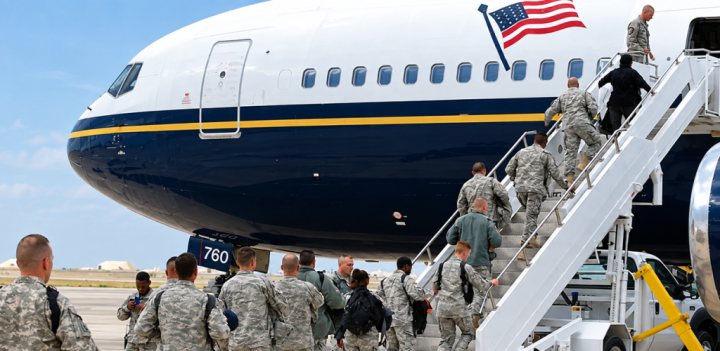
Baghdad, September 30: The withdrawal of US-led coalition forces from Iraq is being portrayed by Iran and its allied groups as a victory after more than two decades of American military involvement in the country.
Around 4,500 US service members were killed during the broader Iraq war and its aftermath. Iran and its allies, which now wield significant political and military influence in Iraq, have welcomed the departure of foreign troops.
Iraqi security experts say the withdrawal was originally agreed upon in 2024 during the administration of President Joe Biden. Despite the United States now being engaged in conflict with Iran, President Donald Trump’s administration has continued with the withdrawal process.
Analysts warn that the departure could provide Iran and its powerful allied groups with greater room to expand their influence. They also fear that groups such as Islamic State could exploit potential security gaps.
Jasim al-Bahdali, an Iraqi security analyst who studies Iran-linked Shiite armed groups, said the coalition’s departure would provide Tehran with a strategic advantage because the military presence that had helped balance Iran’s influence in Iraq for years would be coming to an end.
He also said Iran-backed armed groups could use the opportunity to increase their influence over security and political decision-making in Iraq.
Abu Mujtaba al-Yasiri, commander of the Iran-backed Islamic Resistance in Iraq, described the US withdrawal as a historic victory.
He said the departure represented a victory for Iraqi resistance groups and Iraqis who opposed the American presence, adding that September 30 would mark the removal of what he described as a “dark page” from Iraq’s history.
Concerns Over Iraq’s Security Preparedness
Although the withdrawal of American forces is broadly popular among Iraqis, some people remain concerned that the country is not fully prepared to assume all security responsibilities on its own.
Abdulrahman al-Jubai, a Sunni tribal leader from Fallujah, said Iraqis want complete sovereignty but warned that the departure of the US-led coalition could create a security vacuum.
Fallujah was once a major center of resistance against the US military presence in Iraq.
The United States first invaded Iraq in 2003, overthrowing Saddam Hussein’s government and subsequently establishing a political system led by Shiite parties. After years of fighting insurgents, American forces withdrew at the end of 2011.
US forces returned less than three years later to support Iraqi forces in the fight against Islamic State. Between 2014 and 2017, the US-led coalition played a major role in the campaign that defeated Islamic State’s territorial control in Iraq.
Iraq has also remained one of the few countries in the region with close political and military relations with both Washington and Tehran. At various times, Iraqi territory has been used as a battleground in the wider US-Iran confrontation.
In 2020, the United States carried out a strike near Baghdad airport that killed Iranian military commander Qassem Soleimani. Iran-aligned groups subsequently launched repeated attacks against US bases, while Washington responded with strikes of its own.
Iran and Its Allies Welcome the Withdrawal
Iran has repeatedly said that its long-term objective is to push US forces out of the Middle East. Tehran has therefore welcomed the US withdrawal from Iraq as a major achievement for its network of allied armed groups in the region.
Amir Hayat Moqaddam, deputy head of Iran’s parliamentary National Security Commission, said Monday that permanent security could be established in Iraq once American forces leave the country.
He said Iran welcomed and supported the withdrawal, while describing continued actions by resistance groups against US forces as part of the broader confrontation.
Washington has accused Iran-backed armed groups operating in Iraq of following Tehran’s direction and contributing to instability across the region. The Iraqi government has said it is attempting to limit the influence of such groups.
Could Islamic State Regain Strength?
The departure of US forces has also raised concerns among Iraqi security officials and authorities in the northern Kurdistan region about the possibility of Islamic State regaining strength.
Although Islamic State lost almost all of its territorial control nearly a decade ago, the group still maintains underground networks in Iraq.
At the height of its power, Islamic State controlled roughly one-third of Iraq and carried out mass killings and other atrocities. The group has continued to conduct sporadic attacks despite years of military setbacks.
Kurdish commander Sirwan Barzani warned that the loss of American intelligence, logistical support and drone capabilities could make it easier for Islamic State militants to reorganize.
He said security officials had observed increased Islamic State activity in the weeks leading up to the coalition withdrawal and suggested that the development could boost the militants’ morale.
Iraqi security forces have also reported disrupting an alleged plan by an Islamic State cell to carry out a suicide attack around the time of the military withdrawal.
Four Iraqi security and military officials said the incident highlighted a continuing concern: despite years of military defeats, Islamic State remains capable of exploiting weaknesses in Iraq’s security system.