




|
YTN said Nepal initially rejected “all foreign
assistance” and presented national public opinion as rapidly deteriorating.
Reuters reporting and official Nepali records show a more nuanced picture:
Nepal initially declined additional foreign search-and-rescue teams while
domestic operations were under way, then requested and accepted specialised
international assistance as operational needs evolved. |
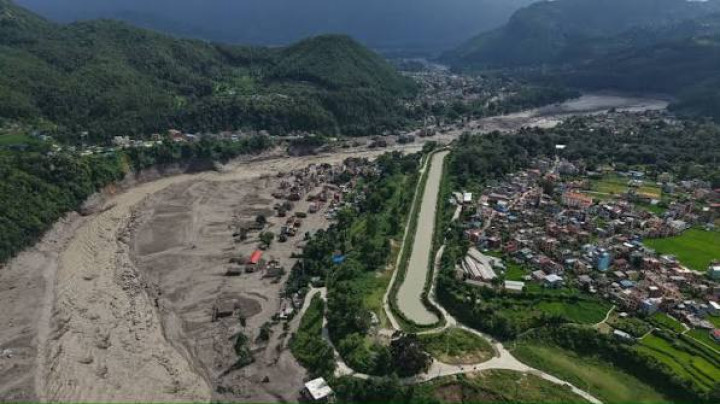
KATHMANDU, September 6, 2026 : A report broadcast by South
Korean news channel YTN on September 4 has drawn attention in Nepal after
presenting a strongly critical account of Prime Minister Balendra Shah and the
government’s handling of the catastrophic Bhote Koshi - Trishuli floods.
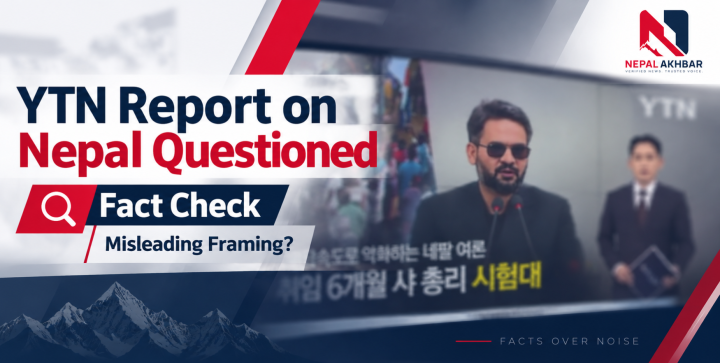
The YTN segment, published as an “Anchor Report,” opened by
declaring that “public opinion among Nepalese people is rapidly deteriorating”
and said the six-month-old government was facing a major test. It went on to
criticise Nepal’s disaster warning system, its handling of foreign rescue
assistance, temporary burials of unidentified victims and even the prime
minister’s wearing of sunglasses.
A review by Nepal Akhbar of the YTN report, Reuters coverage
and official Nepal government statements finds that some of the underlying
events mentioned by YTN are real. However, several important claims are either
overstated, insufficiently supported or presented without essential context.
Did Nepal reject “all foreign help”?
One of the strongest statements in the YTN report says that
the Nepal government “initially rejected all foreign assistance” before later
seeking help from only a few countries.
That wording does not accurately reflect what Reuters
reported at the time.
On August 28, Reuters reported that Nepal had told foreign
governments it did not require foreign search-and-rescue teams “for now,”
because Nepali security agencies were conducting the operations themselves.
Foreign Ministry spokesperson Lok Bahadur Chhetri told Reuters that Nepal’s own
agencies were carrying out search and rescue and that additional foreign teams
were not required at that particular stage.
That is significantly different from rejecting all
international assistance.
The same Reuters report said South Korea had already pledged
US$1 million in humanitarian assistance through international organisations,
while Seoul had sent a response team to Nepal in connection with missing South
Korean nationals.
Nepal’s position subsequently changed as the scale and
specialised nature of the rescue operation became clearer. By August 30,
Nepal’s Ministry of Foreign Affairs said tunnel-rescue experts from India,
China and the Republic of Korea had been mobilised in coordination with the
Nepali Army. The government said it was seeking international assistance where
specialised expertise and equipment were necessary.
On September 1, Reuters reported that South Korea was
sending a 44-member emergency relief team following a request from Nepal for
assistance with search-and-rescue operations.
International rescue cooperation continued afterward.
Nepal’s Foreign Ministry confirmed that Indian, Chinese and South Korean
tunnel-rescue teams were working alongside Nepali forces, while equipment,
drones and other materials received from foreign partners were being used in
ongoing operations.
Therefore, the claim that Nepal simply “rejected all foreign
help” is an overgeneralisation. A more accurate description is that Nepal
initially declined additional foreign search-and-rescue teams, saying domestic
resources were sufficient at that stage, before requesting and accepting
specialised foreign assistance as operational needs developed.
Was Nepalese public opinion “rapidly deteriorating”?
YTN’s headline and opening statement present rapidly
worsening public opinion as an established national fact. However, the
published report does not provide a nationwide opinion poll, approval-rating
survey, sample size, polling organisation or other quantitative evidence
demonstrating such a rapid national shift.
The report instead refers to criticism surrounding disaster
preparedness, flood warnings, international rescue teams, burial procedures and
the prime minister’s personal appearance.
Those issues may legitimately be debated and reported. But
criticism from sections of the public, social media or commentators is not
automatically equivalent to verified evidence that Nepalese public opinion as a
whole is rapidly deteriorating.
Without polling or other representative evidence, YTN’s
broad characterisation should therefore be understood as an assessment or
editorial framing rather than a demonstrated statistical fact.
Temporary burials did occur - but important context matters
YTN also criticised the government’s decision to bury
unidentified flood victims, suggesting that the process was aggravating public
sentiment because Nepal’s Hindu traditions generally favour cremation.
The burials themselves are real and were independently
documented by Reuters.
Reuters reported from Chitwan that unidentified bodies
recovered after spending days in floodwater were decomposing rapidly and
overwhelming available mortuary facilities. Authorities said temporary burial
became necessary because of public-health concerns and the condition of the
remains.
Crucially, Reuters also reported that authorities were
photographing and documenting the bodies, collecting DNA samples, marking
individual graves and recording precise burial locations so remains could later
be identified and exhumed if families were found.
Nepal’s Foreign Ministry gave a similar explanation, saying
temporary burials were being conducted for unrecognisable or severely
decomposed remains under established protocols, with DNA samples preserved so
families could later identify and perform appropriate rituals.
Therefore, reporting merely that Nepal was “hurriedly
carrying out mass burials” without adequately explaining the identification
safeguards and severe public-health situation risks giving viewers an
incomplete impression of why the decision was taken.
Questions over initial foreign-team access were real
It would also be inaccurate to claim that there were no
difficulties involving foreign rescuers.
Reuters reported that the initial attempts of a South Korean
rapid-response team to reach the disaster area were delayed by flight
restrictions imposed by the Nepali military. After approval was granted, aerial
search missions began on August 29.
Reuters had also reported on August 28 that Nepal was not
yet accepting additional foreign search-and-rescue teams, despite offers from
several countries.
Those decisions can legitimately be questioned, especially
given the number of foreign nationals affected. But they should be described
accurately as restrictions and an initial decision not to deploy foreign SAR
teams — not as a blanket rejection of every form of international assistance.
The sunglasses commentary
The YTN report also devoted substantial attention to Prime
Minister Shah’s wearing of sunglasses, saying that because he was already
facing criticism over not visiting disaster areas frequently enough, wearing
sunglasses would inevitably make him appear worse to the public.
That statement is clearly more interpretive than factual.
The report does not provide polling or other representative evidence showing
how much, if at all, the prime minister’s eyewear has affected his nationwide
approval.
Personal presentation can be a legitimate subject of
political commentary, but treating it as evidence of deteriorating national
support without supporting data moves the report away from straightforward
factual reporting.
What verified evidence shows
Reuters’ reporting since the disaster shows that Nepal’s
response has faced extraordinary difficulties and that legitimate questions can
be asked about preparedness, warnings, access and the speed of rescue
operations.
At the same time, the verified record also shows an enormous
domestic and international rescue operation. Reuters reported that thousands of
Nepali security personnel were deployed and that specialised international
teams were participating in efforts to reach people trapped at damaged
hydropower projects.
On September 4, rescuers pulled two workers alive from the
Upper Trishuli 3A hydropower tunnel nine days after the disaster, underscoring
both the extreme difficulty of the operation and the continuing rescue effort.
Nepal Akhbar Fact-Check Verdict
VERDICT: PARTLY MISLEADINGThe YTN report should not be dismissed in its entirety as fake news. Several events it discusses, including initial restrictions on foreign rescue teams, temporary burials and criticism of the government’s disaster response have factual foundations. |
However, two major elements require qualification.
YTN’s statement that Nepal “initially rejected all foreign
assistance” is misleading because verified Reuters reporting shows that Nepal
initially declined additional foreign search-and-rescue teams, while
humanitarian assistance and diplomatic coordination were occurring, and Nepal
subsequently requested specialised international rescue assistance.
Similarly, YTN’s sweeping assertion that “Nepalese public
opinion is rapidly deteriorating” is not supported in the report by a national
poll or other representative public-opinion data.
A more balanced report would distinguish between documented
criticism of the government’s disaster response and a scientifically
demonstrated nationwide decline in public support.
Responsible journalism requires scrutiny of the Nepal
government’s decisions during a disaster of this magnitude. But that scrutiny
should also be based on precise language, verifiable evidence and sufficient
context — particularly when international media are describing an entire
country’s public sentiment.
Primary sources referenced
• Reuters
— Nepal declines foreign rescue help; South Korea says it is negotiating (Aug.
28, 2026)
• Reuters
— South Korea to send disaster relief team to Nepal (Sept. 1, 2026)
• Reuters
— Nepal begins mass burials of unidentified flood victims (Aug. 30, 2026)
• Reuters
— How search operations are progressing in Nepal after deadly flash flood
(Sept. 2, 2026)
• Reuters
— Two people pulled alive from Nepal hydropower tunnel (Sept. 4, 2026)
• Nepal
Ministry of Foreign Affairs — Press briefing on Bhote Koshi flood
• YTN
— Report being fact-checked (Sept. 4, 2026)
Editorial note: This fact-check
separates verifiable events from interpretive or unsupported framing. It does
not argue that Nepal’s disaster response should be exempt from criticism; it
assesses whether the specific claims and wording used in the cited report are
adequately supported by available evidence.