





Kathmandu – Nepal continues to struggle to convert foreign investment commitments into actual capital inflows, while the amount of dividends repatriated by foreign-invested companies remains significantly higher than the country’s annual foreign investment inflows.
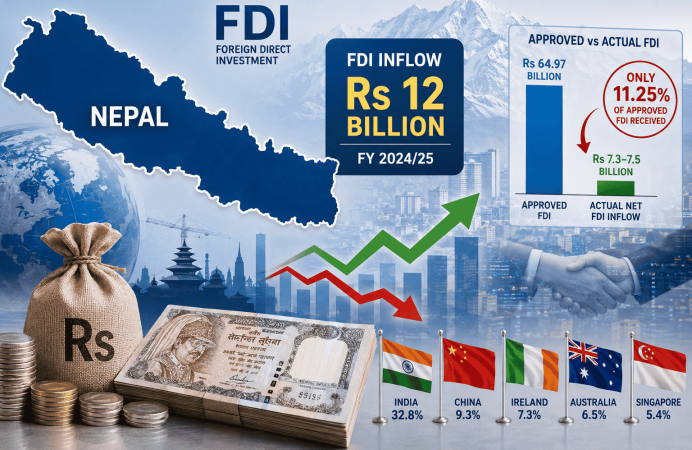
According to the “Foreign Direct Investment in Nepal: Survey Report for Fiscal Year 2024/25” published by the Economic Research Department of Nepal Rastra Bank, Nepal received a total foreign direct investment (FDI) inflow of around Rs 12 billion during the fiscal year 2024/25.
Although the overall FDI inflow remained positive, foreign investors repatriated approximately Rs 4.7 billion during the same period. The amount represents around 39.2 percent of the total FDI inflow.
After accounting for the investment outflow, Nepal’s net FDI inflow stood at approximately Rs 7.3 billion to Rs 7.5 billion, according to the survey.
Large Gap Between Approved and Actual Investment
The report highlights a substantial gap between the amount of foreign investment approved by authorities and the amount that actually enters Nepal.
During fiscal year 2024/25 alone, foreign investment worth Rs 64.97 billion was approved. However, the actual net FDI inflow amounted to only around 11.25 percent of the approved investment.
The long-term trend is also concerning. Between fiscal year 1995/96 and 2024/25, only 29.6 percent of the total foreign investment approved in Nepal was actually brought into the country.
The report attributes the gap to several factors, including investors failing to bring in the full amount initially committed, a time lag between investment approval and actual capital inflow, and the lengthy construction periods required for large projects.
FDI Stock Rises to Rs 340 Billion
Despite the low level of annual inflows, Nepal’s overall stock of foreign direct investment has shown gradual improvement.
The country’s total FDI stock increased by 2.1 percent compared with the previous fiscal year, reaching approximately Rs 340 billion at the end of fiscal year 2024/25.
The increase was mainly driven by additional equity investment and the reinvestment of retained earnings by foreign-invested companies.
Paid-Up Capital Accounts for Largest Share
Paid-up capital represents the largest component of Nepal’s total FDI stock.
Its share increased from 50.7 percent in the previous year to 54.2 percent during the review year.
Similarly, reinvested earnings accounted for 36.9 percent of total FDI stock, representing more than one-third of the total.
Inter-company loans provided between foreign investors and their affiliated companies accounted for 8.9 percent of total FDI stock.
Such loans are primarily used to finance capital-intensive projects. However, the share of inter-company loans declined by 28.1 percent during the review period, suggesting that foreign investors are gradually shifting from debt-based financing toward equity investment.
Energy and Manufacturing Remain Key Investment Destinations
Foreign direct investment in Nepal remains concentrated in a limited number of industrial and service sectors.
The industrial sector accounted for 56.2 percent of total FDI stock, making it the dominant sector.
Within the major sectors, hydropower and energy accounted for 27.8 percent, while manufacturing also represented a significant portion of investment. The service sector accounted for 43.7 percent of total FDI stock.
Within the service sector, financial and insurance services accounted for 26.3 percent, information and communication technology for 8.2 percent, and accommodation and food services—closely linked to Nepal’s tourism industry—for 7 percent.
The report notes that although emerging sectors such as tourism and information technology are gradually gaining importance, foreign investment remains concentrated in a limited number of areas.
It recommends greater diversification of FDI into other sectors to reduce investment risks and generate broader economic benefits.
India Largest Foreign Investor, China Second
Nepal has received foreign direct investment from 60 countries, according to the report.
India remains the largest source of FDI stock in Nepal, accounting for 32.8 percent of total FDI stock.
Indian investment is primarily concentrated in manufacturing, hydropower and energy, and financial services.
China ranks second, accounting for 9.3 percent of Nepal’s total FDI stock. Chinese investment is heavily concentrated in hydropower and the energy sector.
Ireland ranks third with 7.3 percent, followed by Australia with 6.5 percent and Singapore with 5.4 percent.
The United States accounts for 5.2 percent, South Korea for 4.7 percent, and the West Indies for 4.4 percent of Nepal’s total FDI stock.
The distribution indicates a strong presence of Asian countries among Nepal’s major foreign investors.
FDI Heavily Concentrated in Bagmati Province
The geographical distribution of foreign investment across Nepal’s provinces remains highly uneven.
Bagmati Province alone accounts for 64 percent of total FDI, largely due to its infrastructure, market accessibility, and relatively convenient administrative facilities.
Koshi Province ranks second with 13.4 percent, while Gandaki Province accounts for 10 percent.
Madhesh Province receives 6.8 percent, followed by Sudurpashchim Province with 4.2 percent, Lumbini Province with 1.4 percent, and Karnali Province with less than 1 percent.
The figures highlight the significant regional imbalance in the distribution of foreign investment and point to the need for policies aimed at attracting investment to less-developed provinces.
Foreign Companies Repatriate Rs 33.91 Billion in Dividends
Foreign-invested companies operating in Nepal repatriated a total of Rs 33.91 billion in dividends during fiscal year 2024/25.
The manufacturing sector accounted for the largest share, repatriating approximately Rs 28.99 billion in dividends.
The financial and insurance sector ranked second, repatriating around Rs 3.74 billion.
The large volume of dividend repatriation compared with annual FDI inflows highlights the continuing challenge of ensuring that foreign investment generates sustained capital formation within Nepal.
Moderate Financial Performance of Foreign-Invested Companies
The survey also found that foreign-invested industries and businesses recorded moderate financial performance during the review period.
The total operating sales revenue of the companies covered by the survey stood at approximately Rs 470.8 billion in fiscal year 2024/25.
This represented a slight 0.7 percent decline from the previous year, when operating sales revenue stood at around Rs 474 billion.
The average return on equity (ROE) of foreign-invested companies stood at 11.2 percent, compared with 11.4 percent in the previous fiscal year.
Foreign Borrowing Increases
Foreign-invested companies in Nepal have increasingly relied on external commercial borrowing to meet long-term capital requirements, particularly in the hydropower and manufacturing sectors.
By the end of fiscal year 2024/25, the outstanding foreign debt of companies with foreign investment—excluding direct loans received from foreign direct investors—had reached approximately Rs 75.79 billion.
This was a significant increase from Rs 59.88 billion recorded in the previous fiscal year.
Hydropower and energy companies accounted for the largest share of this borrowing, with outstanding foreign debt of approximately Rs 52.82 billion.
Manufacturing Capacity Utilization Improves
The survey also reports a significant improvement in the average capacity utilization of foreign-invested manufacturing industries.
Capacity utilization stood at 47.5 percent in fiscal year 2023/24 but increased substantially during the review year.
The report indicates that manufacturing industries have yet to operate at full capacity, suggesting considerable potential for improving operational efficiency and expanding market demand.
Key Takeaway
Nepal’s FDI figures reveal a mixed picture. While the country’s overall FDI stock is gradually increasing and investment from major economies remains significant, the actual inflow of foreign capital continues to fall far short of approved commitments.
At the same time, substantial dividend repatriation, geographical concentration of investment, and dependence on a limited number of sectors remain major challenges.
The Nepal Rastra Bank survey suggests that improving the implementation of approved investments, diversifying investment across sectors and provinces, and creating a more conducive environment for long-term capital formation will be crucial for Nepal to derive greater economic benefits from foreign direct investment.